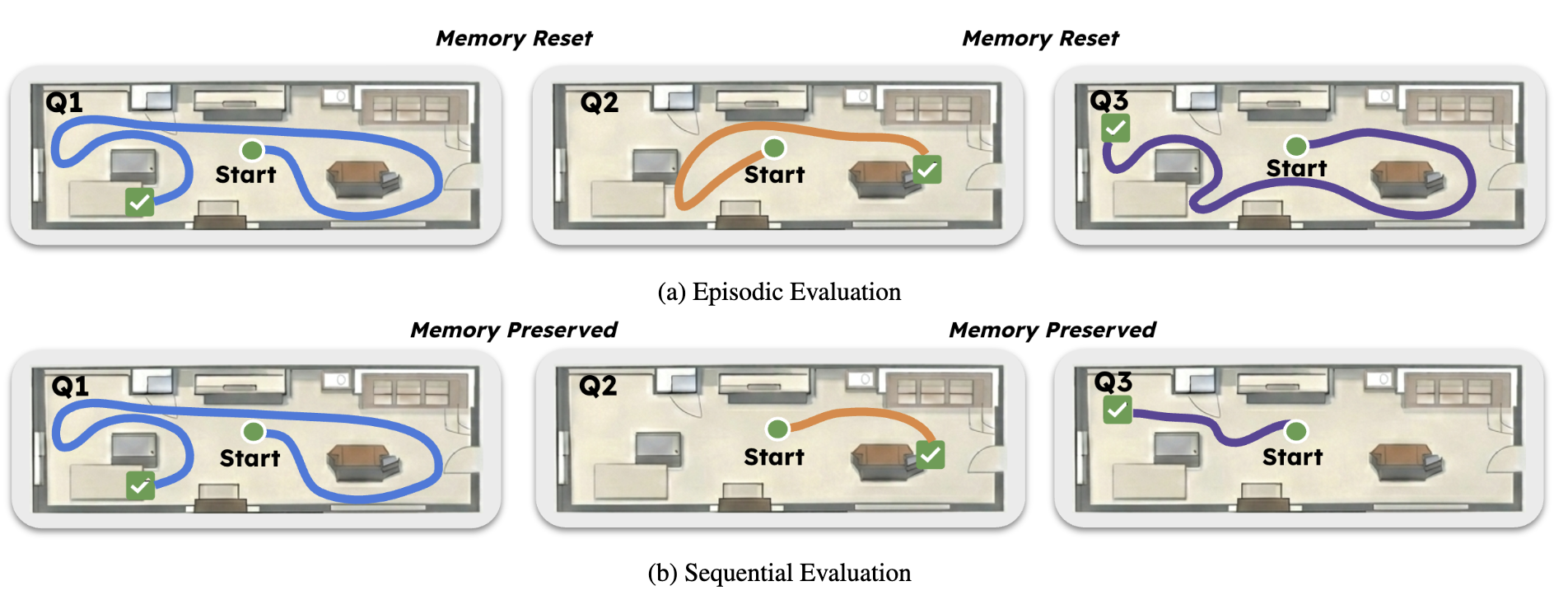
Embodied question answering (EQA) is usually evaluated episodically, with every task solved independently and internal state reset between episodes. Real robots instead operate continuously and must retain and selectively reuse knowledge from earlier interactions. We study how several memory architectures behave in a sequential EQA protocol, where an agent answers multiple questions in the same scene while carrying memory across queries. Simply leaving memory enabled is not enough: 2D occupancy maps preserve traversability but lose visual-semantic evidence, while policies trained on short episodic histories suffer from temporal distribution shift when exposed to long, multi-query context. Structured, spatially grounded memory overcomes this bottleneck by anchoring persistent visual observations to metric 3D geometry. Across simulated environments, this representation improves answer accuracy while reducing navigation cost. Real-world experiments on a mobile robot further show that spatially grounded visual memory is essential for continuous embodied reasoning.